

7.21.2014
Research
Not a bad selection. I even spotted another future goal "Bicycling the Pacific Coast: Canada to Mexico"


7.16.2014
Stuff Bicyclists Like - Insanely Long, Perhaps Reckless Bike Rides
You know those nagging thoughts that linger in your mind, itching and gnawing every once in a while? Whenever I get one of those I think back to what I learned in the best film I've ever seen in my life:
Quest: 100 mile bike ride
Destination: a friend's place in Davis, CA (will have to check in with them first or else risk crashing at the Amtrak station...on the plus side there's an In-N-Out nearby)
Prep: buy bike patches, eat more protein, stop eating cookies and froyo
Logistics: route map pending
Countdown: 10 days
“Farmer Hoggett knew that little ideas that tickled and nagged and refused to go away should never be ignored, for in them lie the seeds of destiny.” -BabeWell, I've had this idea for a couple years now, so while I don't think it'll reveal any sort of destiny, I can't ignore it much longer.
Quest: 100 mile bike ride
Destination: a friend's place in Davis, CA (will have to check in with them first or else risk crashing at the Amtrak station...on the plus side there's an In-N-Out nearby)
Prep: buy bike patches, eat more protein, stop eating cookies and froyo
Logistics: route map pending
Countdown: 10 days
Will update soon
--------- End of mission log ---------
3.25.2014
Some favorite places in Berkeley

Click image to view interactive map with comments on selected places.
3.22.2014
To Build a Home
There is a house built out of stone- "To Build a Home" The Cinematic Orchestra
Wooden floors, walls and window sills
Tables and chairs worn by all of the dust
This is a place where I don't feel alone
This is a place where I feel at home
I can't wait to be home. Being in a state of errantry is exciting, and I've never wanted to be one to be tied down to one place, but there's something about a home. Maybe it's because I've been listening to Mercedes Sosa, but I mean really listening to it.
Empeze con la cancion "me gustan los estudiantes" y memorize la letra. Estuve tan feliz escuchandolo que hasta estuve cantandolo mientras camine a mis clases y no me importo quien me escuchaba. Luego escuche "Gracias a la vida:"
Gracias a la vida que me ha dado tanto
Me ha dado el sonido y el abecedario
Con el, las palabras que pienso y declaro
Madre, amigo, hermano
Y luz alumbrando la ruta del alma del que estoy amando
Gracias a la vida que me ha dado tanto
Me ha dado la marcha de mis pies cansados
Con ellos anduve cuidades y charcos
Playas y desiertos, montañas y llanos
Y la casa tuya, tu calle y tu patio
Esa cancion tiene una cualidad inquietante- susurra en mi oido y el alma de tiempos pasados con mi familia y historia, pero tambien de tiempos que aun no han venido. Ese sentimiento es a la vez emocionante y tranquilo.
No se de lo que estoy diciendo. Queria practicar escribiendo en español, comi mucha azucar anoche y estoy emocionada que voy a regresar a mi casa- al lugar donde se que estan la gente que amo con toda mi vida.
Y queria escribir tambien. La proxima vez voy a practicar el uso de acentos.
Bueno.
Hasta la proxima vez!
10.19.2013
4.27.2013
How cities can promote environmental justice
Maybe cities aren't the best proponents of environmental justice (as of now). Most often, cities are the scene of the crime - fires at a Chevron refinery in Richmond, CA, air pollution from the port in Wilmington, CA. These cases and others like it impact already vulnerable communities the most, but it doesn't have to be so.
Environmental Justice. It was hard to define this especially because I hear so many different meanings. But the best and clearest definition I've heard comes from activist Majora Carter "no community should be saddled with more environmental burdens and less environmental benefits than any other." In her TED talk, Carter speaks of how the creation of a greenway along the South Bronx waterfront transformed the surrounding neighborhoods with green open spaces and mixed-use economic development.
I am inspired to think that cities don't have to be the sites of social and environmental degradation anymore.
Here is Majora Carter on "Greening the Ghetto"
Environmental Justice. It was hard to define this especially because I hear so many different meanings. But the best and clearest definition I've heard comes from activist Majora Carter "no community should be saddled with more environmental burdens and less environmental benefits than any other." In her TED talk, Carter speaks of how the creation of a greenway along the South Bronx waterfront transformed the surrounding neighborhoods with green open spaces and mixed-use economic development.
I am inspired to think that cities don't have to be the sites of social and environmental degradation anymore.
Here is Majora Carter on "Greening the Ghetto"
3.25.2013
Me on Vacation

From either humortrain.com or failblog.org (I forget)
Ugh, the sad truth. It's spring break and I have to drag myself to go outside. But so far, it has not been a total waste. I went to a Trader Joe's for the first time and splurged on their chocolate almonds. It's the small victories that count.
The big victory is that I survived near death by challenging my inexperienced Angeleno legs to bike San Francisco's hilly streets, much to the annoyance of the motorists behind me. Never mind the hills, the ridiculous wind speed alone almost toppled me into the car's path. I'm exaggerating, but those winds do travel really fast.
So, chocolate almonds and conqueror of Market Street, SF. Pretty good start to my first spring break away from home.
 |
| Farmer's Market at Market/7th St |
2.19.2012
Millard Canyon Hike
I like to sleep in until 10am when there's no class I have to push myself out of bed for, but I woke up at 6:22am this Sunday morning ready to go hiking in Altadena near JPL.
 The day had a rough start. There was a group of us going in a small bus, but two of my friends went on their own and got desperately lost, never making it to the canyon. Although from what they described, they did have an exasperatingly hysterical adventure of their own, getting lost in the canyon and having a run in with a Jet Propulsion Lab security guard (never to be messed with) and getting mistaken for house maids in a gated community. But that's definitely a whole other story.
Those of us on the bus headed out from Pasadena City College in the right direction thankfully. Along the way we passed the haunted/Enchanted Forest where my friend described the morbid details behind the forest's notoriety. Evidently, there used to be a meat processing plant underground, somewhere in the canyon wall I suppose, where two men dragged their victims to their deaths. Though now teenagers and college students dare themselves and their friends into the canyon during the dead of night, keeping an eye out for ghosts and scarily enough, the cops. The bus rumbled on and we passed near Gravity Hill where, as the story goes, the ghosts of schoolchildren from a horrible accident push your car up the hill while the car is in neutral. We passed the places of these (could be true) urban legends and headed into Millard Canyon.
 We had reached the Millard campgrounds and gotten off the bus before I, mortified, realized that this wasn't the place we were meeting the volunteers from another organization. The bus was about to leave stranding us, but my friend signaled the driver and let him know that this wasn't the right place. We boarded the bus again and headed down the canyon towards JPL finally reaching the right road.
We had planned to join with a local environmental organization called the Arroyo Seco Foundation, but found that they had headed up the canyon trail before we got there. However, one of the organization volunteers was thankfully notified that we were trying to reach them and so came down to meet us.
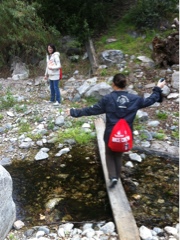
Once in the canyon we wound our way through jutting rocks and the small streams sheltering the small frogs that call the canyon home. We passed over makeshift wooden planks over larger streams, careful not to let any one of us fall into the water. One of volunteers had smartly brought his rain boots and was able to make his way through the course of the stream without fear of getting wet.
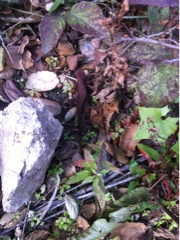 In addition to frogs we also found a salamander that was accidentally startled when one of our participants passed a little too close to it prompting the salamander to hurriedly make it's way up the canyon from the stream.
The main reason we went in the hike though was to pick up trash and so as soon as we met up with the rest of the group, which consisted of a couple girl scouts and boy scouts earning their badges with their parents, we got some trash bags and those metal trash picker uppers whose name escapes me and began to look for any trash around the canyon.
It was a really fun time. We learned a bit about the plants around and how it was used in the past. For instance, the Native Americans used mule fat for bows and arrows because of how straight it is. Though it's called mule fat because miners on their way up the canyon would feed their mules the plant to keep them nourished.
The air was fresh and brisk and there were only a couple of people on the canyon trail with their dogs. Though it felt isolated and was quiet, at the top of the canyon to the side were houses, which might have explained a rusty sink we found at the bottom of the canyon.
Bonus: There's a couple great bike paths near the canyon that go alongside the stream and JPL.
I will definitely be returning soon.
The day had a rough start. There was a group of us going in a small bus, but two of my friends went on their own and got desperately lost, never making it to the canyon. Although from what they described, they did have an exasperatingly hysterical adventure of their own, getting lost in the canyon and having a run in with a Jet Propulsion Lab security guard (never to be messed with) and getting mistaken for house maids in a gated community. But that's definitely a whole other story. Those of us on the bus headed out from Pasadena City College in the right direction thankfully. Along the way we passed the haunted/Enchanted Forest where my friend described the morbid details behind the forest's notoriety. Evidently, there used to be a meat processing plant underground, somewhere in the canyon wall I suppose, where two men dragged their victims to their deaths. Though now teenagers and college students dare themselves and their friends into the canyon during the dead of night, keeping an eye out for ghosts and scarily enough, the cops. The bus rumbled on and we passed near Gravity Hill where, as the story goes, the ghosts of schoolchildren from a horrible accident push your car up the hill while the car is in neutral. We passed the places of these (could be true) urban legends and headed into Millard Canyon.
We had reached the Millard campgrounds and gotten off the bus before I, mortified, realized that this wasn't the place we were meeting the volunteers from another organization. The bus was about to leave stranding us, but my friend signaled the driver and let him know that this wasn't the right place. We boarded the bus again and headed down the canyon towards JPL finally reaching the right road. We had planned to join with a local environmental organization called the Arroyo Seco Foundation, but found that they had headed up the canyon trail before we got there. However, one of the organization volunteers was thankfully notified that we were trying to reach them and so came down to meet us.
Once in the canyon we wound our way through jutting rocks and the small streams sheltering the small frogs that call the canyon home. We passed over makeshift wooden planks over larger streams, careful not to let any one of us fall into the water. One of volunteers had smartly brought his rain boots and was able to make his way through the course of the stream without fear of getting wet.
 |
| Can you see the frog?? |
In addition to frogs we also found a salamander that was accidentally startled when one of our participants passed a little too close to it prompting the salamander to hurriedly make it's way up the canyon from the stream. The main reason we went in the hike though was to pick up trash and so as soon as we met up with the rest of the group, which consisted of a couple girl scouts and boy scouts earning their badges with their parents, we got some trash bags and those metal trash picker uppers whose name escapes me and began to look for any trash around the canyon.
It was a really fun time. We learned a bit about the plants around and how it was used in the past. For instance, the Native Americans used mule fat for bows and arrows because of how straight it is. Though it's called mule fat because miners on their way up the canyon would feed their mules the plant to keep them nourished.
The air was fresh and brisk and there were only a couple of people on the canyon trail with their dogs. Though it felt isolated and was quiet, at the top of the canyon to the side were houses, which might have explained a rusty sink we found at the bottom of the canyon.
Bonus: There's a couple great bike paths near the canyon that go alongside the stream and JPL.
I will definitely be returning soon.
2.04.2012
Financial Literacy 101 - Scholarships!
I'm a broke college student. Tuition at the UC's run up to $4000 a quarter for a estimated total of $13000 a year including fees :( The number of students graduating with a debt from loans is frightening. Some debts can go up to $15000.
So one Saturday, I went to the UCLA CCCP Financial Literacy workshop and learned that there is help out there, and more importantly, that there is something I can do about it. Here was the agenda for the day:
Workshop 1: Scholarship Tips
Workshop 2: Financial Literacy
Workshop 3: Employment Strategies
So one Saturday, I went to the UCLA CCCP Financial Literacy workshop and learned that there is help out there, and more importantly, that there is something I can do about it. Here was the agenda for the day:
Workshop 1: Scholarship Tips
Workshop 2: Financial Literacy
Workshop 3: Employment Strategies
1.24.2012
Some Wise Words
Do not spoil what you have by desiring what you have not; but remember that what you now have was once among the things you hoped for.
- EpicurusI saw this posted up in the office of a friend today. It's really helped me stay grounded and optimistic. Sometimes words catch me by surprise. They're scratch marks on a paper or ink on a screen, but woven in just the right way, they can be beautiful, inspiring, hurtful, powerful, heartfelt and genuine.


1.23.2012
1.22.2012
Einstein: Human+Genius
Arioso from Cantata, Johann Sebastian Bach
Einstein. It is synonymous to genius, encompassing one man's life of perpetual curiosity and creativity. But if one were to comment on J. Edgar Hoover's secret campaign against Einstein, one would be as incredulous as Sam Papich, FBI's former liaison officer, "Einstein? Albert Einstein? Why would we ever have a file on him?" (Jerome xx)
How could we not know? Why did Hoover hide it from even within his own FBI? What was so threatening about the wild-haired professor? These questions unravel another life of Einstein we did not know, both grave and light-hearted, but paving the path to Einstein's unintended legacy.
This is the thesis of my website entry to the History Day competition. The 2009 theme was "The Individual in History: Actions and Legacies." It was one of the best experiences of my high school career. I obsessed over this contest for days, tweaking css styles, adding paragraphs and videos. I labored over this project, but it was very satisfying seeing the little symbols of code become an image, an mp3 embedded file. It was, in a word, awesome.
And it's up again! Human/Genius: The Face(s) of Einstein


There are only two ways to live your life. One is as though nothing is a miracle. The other is as though everything is a miracle. -Albert Einstein
1.17.2012
Stuff Bicyclists Like - Spoke Cards
For my first assignment in my cultural anthropology course, I have to write a 4 page commentary on the website Stuff White People Like. I've taken a quick look at it, enough to satisfy my happiness that this is not going to be a boring, dry assignment, which is great. Another part of the assignment is to write a "stuff my people like" entry. I immediately thought of bicyclists.
I protested getting a driver's license as long as I could, but my parents practically shoved me into the DMV when I turned 20. So now I drive, begrudgingly, with a permit and I'm in no hurry to take the test. Well, maybe in a bit of a hurry. I really want to drive up north to Montaña de Oro or San Simeon. But anyway, the reason I detest automobiles is because I am first a bicyclist.
The reasons are multiple and varied. Inexpensive, environmentally friendly, fun and cool. I love bicycles. I've been riding since I was in the 3rd grade. So yeah, I'm part of the community. That's not to say I'm an expert though. Just like with any society, a group is filled with many perspectiveS and that's a capital S in bold because that's the way my Anthro Professor wrote it. The S means to be aware of oversimplification at the risk of stereotypes. A group has many individuals, each with their own perspective and belief.
That's a long-winded explanation of this post...
So, stuff bicyclists like. Spoke Cards!
I'm not sure whether they have any specific function. I've heard some people say that certain spoke cards represent the group rides one has been on. This particular one was made by a pretty cool guy named Woody, who volunteers at the Los Angeles County Bicycle Coalition. It definitely has a humanistic/political message. I also think some spoke cards just look cool and have an aesthetic appeal.
I protested getting a driver's license as long as I could, but my parents practically shoved me into the DMV when I turned 20. So now I drive, begrudgingly, with a permit and I'm in no hurry to take the test. Well, maybe in a bit of a hurry. I really want to drive up north to Montaña de Oro or San Simeon. But anyway, the reason I detest automobiles is because I am first a bicyclist.
The reasons are multiple and varied. Inexpensive, environmentally friendly, fun and cool. I love bicycles. I've been riding since I was in the 3rd grade. So yeah, I'm part of the community. That's not to say I'm an expert though. Just like with any society, a group is filled with many perspectiveS and that's a capital S in bold because that's the way my Anthro Professor wrote it. The S means to be aware of oversimplification at the risk of stereotypes. A group has many individuals, each with their own perspective and belief.
That's a long-winded explanation of this post...
So, stuff bicyclists like. Spoke Cards!
 |
| Food Not Bombs |
What are your thoughts?
Final Round
Thank you everyone for voting for my blog post "A Walk Up the Mountain" here at Urban Postcard.
I'm a finalist in the 5.11 Tactical Adventure Contest!
You can vote for my blog post by clicking on the "share" link located on the far left side at the 511 News Blog
Thanks again everyone! I really hope you like my post.

I'm a finalist in the 5.11 Tactical Adventure Contest!
You can vote for my blog post by clicking on the "share" link located on the far left side at the 511 News Blog
Thanks again everyone! I really hope you like my post.

12.29.2011
A Walk Up The Mountain
We were preparing for the
long hike: 11,760 feet to Kersage pass carrying our sleeping bags, tents, crunched up food in two bear canisters, a lot of water, a small propane powered stove, propane canisters, tools, clothes and other small items like chap stick. My father and brother were carrying about 30 pounds of equipment on their backs. I was only carrying
15 pounds though because they were gentlemen and in no way could I manage 30 pounds, having exercised a little to none within the past months. Our
breakfast was cookies and water. We left the car in the parking lot and started up the path.
 |
| My brother and I take a rest |
I was keeping up at first,
but I began to tire after the first mile. The backpack began to dig into my shoulders and where before I was
breathing calmly through my nose, I now was gasping for air. The wind cooled my face, but my harsh breathing burned my
throat. I didn’t say
anything yet though, because my father and brother didn’t seem to be struggling
and I didn’t want to be the one to hold them up. I reassured myself that I wasn’t weak. I was suffering from jet lag, having come up northeast 239 miles, which wasn't much I realized, but anything to reassure my ego.
We had reached the first lake and took a break at a giant boulder, setting our backpacks down. I grabbed a Tiger Milk bar while my
brother glared. At REI, he made it clear that the Tiger Milk bars
were his and that I could have the PowerBars. I ate the Tiger Milk
bar in front of him.
The wind went whistling through the
mountain pass. It was cool and dry. There were a couple
of other straggling backpackers making their way up the meandering pass. I had been to Yosemite National Park before and the contrasts between this part of the Sierra and the other parts forming Yosemite is incredibly stark. Yosemite is swarming with not only state and national backpackers and campers, but also international people too. Here, I've seen maybe 10 people pass by us.
We were on the east side
of the Sierra Nevadas, near Owens Valley, an already desolate place due to the rain shadow of the mountain. I learned in my geography course that when the westerly winds confront the west face of the Sierra, the winds rise up the mountains creating uplift, which in turn, produces rainfall and snowfall. However, the east side, without the westerlies, becomes a desert or steppe climate. As
we were driving up from Los Angeles, passing the valley I thought that the city
had an abandoned feel to it. “There’s Manzanar,” my dad said at one
point. It looked like nothing more but a skeleton of what remained
of the barracks. As we passed Manzanar I thought, what a lonely place. It’s a
desert, barren and bleak. But actually, it wasn't exactly so.
Through my school, Pasadena City College, I recently got to go the Manzanar Pilgrimage. I witnessed a vibrant community surrounding the event. Taiko drums call out resoundingly and people of many faiths come together at the event. Colorful paper cranes hang at the foot of the monument near a man playing the bag pipes.
I stared at the still waters of the lake thinking about Manzanar and Owens Valley left to dust after the LA aqueduct. The water of the lake weas trapped in what looked like a giant pothole, which explains its name big
Pothole Lake, created by glaciation that once covered the Sierra with 100 miles of ice during the Pleistocene Epoch. Gradually, my breathing steadied and I finished the last bit of the Tiger Milk bar. This isn’t so bad, I thought. Then, my
father strapped on his backpack and suggested we go on.
We walked mostly in silence. My father's a man of few words, not that he's emotionally distant though. We talk aplenty when there's something to talk about, but when there isn't we succumb to our own thoughts. My brother was lost in his own reverie, and was about fifty meters away so I couldn't speak to him.
 |
| Rain shadow east of the Sierra |
 |
| Manzanar Pilgrimage April 2011 |
Through my school, Pasadena City College, I recently got to go the Manzanar Pilgrimage. I witnessed a vibrant community surrounding the event. Taiko drums call out resoundingly and people of many faiths come together at the event. Colorful paper cranes hang at the foot of the monument near a man playing the bag pipes.
 |
| Pothole Lake created from glaciation millions of years ago |
The path incline became slightly
steeper. I could hear only the crunch of the rocks under my
shoes. I stopped frequently with the pretext of needing a stretch,
turning right to left while trying to catch my breath. I fiddled
with the backpack adjustments until my dad said, “Only a few hundred meters
more.”
"What’s that in feet?” I asked.
"What’s that in feet?” I asked.
“Like six to eight hundred,” he replied. I sighed resignedly, but began counting the steps I took, looking forward to the moment I reached six to eight hundred.
 |
| A view from the top |
 |
| What lies on the other side |

10.19.2011
Transit Priority: The Bookstore
On the bus or train, I usually have my head down studying my English notes or looking out the window listening to guitar tracks from Rodrigo y Gabriela. But sometimes I like to look at the other riders.
Oftentimes, they're also head down, thumbs tapping away at the screen of their smartphones. Most times their earphones are also plugged into their ears. I see one middle-aged man rustling his newspaper as he flattens out the next page. But he's just one.
I'm not passing judgment, but does the conspicuous lack of books mean anything about this technological era? Maybe those stories are all on iPads and Kindles. And I guess there's nothing wrong with that, but I prefer holding books, returning back to the dog-eared page. There's something reassuring in their weight, their physicality.
There is no bookstore in the Montebello Town Center. There used to be a Borders. That was the first store I would see as a kid when my dad would take us to the mall. I loved browsing through the titles, randomly picking up a book and reading the first words. That bookstore is gone now and I don't think there's another one within miles. I know about the comic bookstore on Beverly, but I'm writing about bookstores like Barnes & Noble, not that I have anything against comics. But this lack of bookstores, I wonder what that says about Montebello.
10.11.2011
The World in 2050 Lecture Review Continued
Four forces are inciting change in the North and they are demographics, natural resources, globalization, and climate change. Climate change future projections demonstrate that social, lifestyle choices really matters over the long run, global warming is neither truly global or truly warming and lastly, some places will be hit even worse while other places may actually benefit from climate change.
The Arctic is one of those places that will be dramatically altered for the worst. Professor Smith recounted a story about Jim Martell's hunting experience in northern Canada, recently in 2007. Martell had gone up to canada to hunt and shot what he thought was a polar bear. However, when he got closer to the bear, Martell saw that the bear closely resembled a grizzly bear and in fact, it was later verified that this bear was a polar bear/ grizzly crossbreed, now dubbed "pizzly." There have only been two incidents such as these, but it is possible to infer that grizzly bears are moving north into the arctic due to the warming. I was surprised when Professor Smith stated that plants and animals are moving north at the rate of 6.1 km/decade, which is roughly 6ft per day. Seal hunting was a booming business in Greenland, but now potato farms are on the rise, which is contributing significantly to Greenland's economy. This is also because of global warming.
Not all news related to climate change are positive. The Mountain Pine Beetle in Canada completely destroys acres of forests and communities. The population had been kept in check before by the winter frost, but now the beetle population is growing.
In my previous post, I mentioned briefly that the sea ice extent is decreasing, which means that there will be more development in shipping routes across the Arctic ocean and even through the North Pole. Unlike Antarctica, which is a continent under a lot of ice, the North Pole is just floating sea ice, albeit a lot of floating sea ice. Many of the northern countries, especially Canada, Russia and Greenland are looking to claim a piece of the Arctic Sea as their own, however each country must scientifically prove that the sea is an extension of their country. These shipping routes contribute to the rapid increase of exploitation activity through the Arcitic including activities such as mining and oil.
While the shipping routes are increasing, landscapes in the North are transforming into wild, abandoned land. In Barrow, Alaska the permafrost thaw becomes wet mud. Permafrost is stabe as long as it doesn't thaw, but the rising temperatures cause permafrost thaw, which in turn causes buildings to crack and collapse.
In terms of human demographics, Canada's population is expected to grow 31% by 2050 because of immigration. Canada runs their immigration policy primarily through skilled labor and then family reunification. In 2050, the world will be beginning to compete for skilled immigrants and this is already apparent in Toronto, Helsinki, and Stockholm. Greenland is witnessing a rising population of Inuit Eskimo.
In summary, Professor Smith outlined two important factors contributing to change in the North:
The Push - global pressures from
rising urban population and prosperity
rising natural resources, hydrocarbon demand
globalized business model and workforce
rising temperatures, coastal hazards, droughts, floods
species extinction and biodiversity loss
The Pull
milder winters
rising biomass and biodiversity
water abundance
rising maritime access (but not land)
highly globalized economies
secure peaceful borders
some favorable demographics
rising immigration
The lecture definitely provided interesting topics of discussion. For instance, one man asked how the Inuit Eskimos feel about the rising development and expansion of shipping routes in the North and the professor responded that they want business to develop there. It was an interesting evening. I didn't care so much for the time since it began at 8pm and didn't end until around 9:30, but it was a great lecture.
The Arctic is one of those places that will be dramatically altered for the worst. Professor Smith recounted a story about Jim Martell's hunting experience in northern Canada, recently in 2007. Martell had gone up to canada to hunt and shot what he thought was a polar bear. However, when he got closer to the bear, Martell saw that the bear closely resembled a grizzly bear and in fact, it was later verified that this bear was a polar bear/ grizzly crossbreed, now dubbed "pizzly." There have only been two incidents such as these, but it is possible to infer that grizzly bears are moving north into the arctic due to the warming. I was surprised when Professor Smith stated that plants and animals are moving north at the rate of 6.1 km/decade, which is roughly 6ft per day. Seal hunting was a booming business in Greenland, but now potato farms are on the rise, which is contributing significantly to Greenland's economy. This is also because of global warming.
Not all news related to climate change are positive. The Mountain Pine Beetle in Canada completely destroys acres of forests and communities. The population had been kept in check before by the winter frost, but now the beetle population is growing.
In my previous post, I mentioned briefly that the sea ice extent is decreasing, which means that there will be more development in shipping routes across the Arctic ocean and even through the North Pole. Unlike Antarctica, which is a continent under a lot of ice, the North Pole is just floating sea ice, albeit a lot of floating sea ice. Many of the northern countries, especially Canada, Russia and Greenland are looking to claim a piece of the Arctic Sea as their own, however each country must scientifically prove that the sea is an extension of their country. These shipping routes contribute to the rapid increase of exploitation activity through the Arcitic including activities such as mining and oil.
While the shipping routes are increasing, landscapes in the North are transforming into wild, abandoned land. In Barrow, Alaska the permafrost thaw becomes wet mud. Permafrost is stabe as long as it doesn't thaw, but the rising temperatures cause permafrost thaw, which in turn causes buildings to crack and collapse.
In terms of human demographics, Canada's population is expected to grow 31% by 2050 because of immigration. Canada runs their immigration policy primarily through skilled labor and then family reunification. In 2050, the world will be beginning to compete for skilled immigrants and this is already apparent in Toronto, Helsinki, and Stockholm. Greenland is witnessing a rising population of Inuit Eskimo.
In summary, Professor Smith outlined two important factors contributing to change in the North:
The Push - global pressures from
rising urban population and prosperity
rising natural resources, hydrocarbon demand
globalized business model and workforce
rising temperatures, coastal hazards, droughts, floods
species extinction and biodiversity loss
The Pull
milder winters
rising biomass and biodiversity
water abundance
rising maritime access (but not land)
highly globalized economies
secure peaceful borders
some favorable demographics
rising immigration
The lecture definitely provided interesting topics of discussion. For instance, one man asked how the Inuit Eskimos feel about the rising development and expansion of shipping routes in the North and the professor responded that they want business to develop there. It was an interesting evening. I didn't care so much for the time since it began at 8pm and didn't end until around 9:30, but it was a great lecture.
The World in 2050 Lecture Review
Friday, October 6 was the first lecture by the Los Angeles Geographical Society I attended. It was called The New North: Four Forces Shaping the World in 2050 and it was presented by Laurence C. Smith, Professor and Vice-Chair of Geography at UCLA.
Climate Change
So the future looks pretty grim. Indeed, Professor Smith stated that even an aggressive reform would not entirely help, but he asserted that this does not mean that we throw up our hands and give up. This should actually inspire people to take action.
Professor Smith discussed his research, which spanned 15 months over 2006 and 2007 through a Guggenheim Fellowship studying Arctic climate change and its impact on the people of the north. I was surprised that the lecture closely related the material I am studying in my geography courses at school. Professor Smith spoke a bit about Iceland and Russia and in my mind I felt proud that I knew certain geographical features of Iceland and Russia's dash for a piece of the Arctic Ocean. I know it seems trivial, but when I've attended these sorts of conferences in the past, I didn't have the background knowledge to understand the information being presented. I vaguely remember attending a cognitive science lecture at the Los Angeles Convention Center (I don't remember when or why I was there) and I could not understand anything. I did get to hold an actual brain, but as far as information went, I could not process the knowledge. So, it feels pretty good that I can go to a geographical lecture and connect the decreasing extent of sea ice and what that means for shipping routes in the Arctic (very big expansion).
The lecture focused on four forces:
1. Demographics - urbanization, migration
2. Natural Resources
3. Globalization - trade deregulation, multi-national corporations
4. Climate Change
Demographics
In 2008, the world surpassed a major threshold. More people were now living in the cities than in rural areas. I wonder if that means that the Anthropocene epoch is indisputably here? The human population is growing, but interestingly fertility rates in developing countries are declining.
Natural Resources
There is a recurring theme amongst the book world regarding natural resources and that is "conflict" especially in Iraq and the Middle East. This theme of resource conflict emerged again and again in Professor Smith's lecture, which is influenced by climate change.
Climate Change
The seal level is rising and the snow level illustrates a downward trend. Meanwhile, CO2 emissions are continuously rising. The figure below projects what the future looks like based on three emissions scenarios: low growth, moderate growth and high growth.
 |
| Source: NASA Earth Observatory, based on IPCC Fourth Assessment Report (2007) |
1. Social choice really matters in the long run
2. Global warming is neither truly global or warming
3. Some places will be hit even worse by climate change
One of those places to be hit hardest is the North, which will be the topic of my next blog post
9.30.2011
Project for Positive Change
My final project for my Critical Thinking course is to "concretize some of the theoretical concepts we have been investigating, in particular alienation (both interpersonal and intrapersonal), division of labor and commodity fetishism." So, we've analyzed Marx's German Ideology and Althusser's Ideological State Apparatus, which were interesting and demanding reads that analyzed alienation and division of labor within society and the individual.
Anyways, the final project is called Project for Positive Change. I don't feel alienated at the moment. Maybe during midterm week or finals that might change, but at the moment I'm kind of excited about this.
Week 4
If only more people would__________that would make my life and the lives of my community members better.
I knew I wanted to work with bicycles, but I didn't know what issue to approach. I thought about expanding bicycle safety education, especially after a spirited debate with a colleague about the bicycling trend in Los Angeles (of which he was adamantly against). I'm still not really sure what I want to do for this project and for the sake of this assignment I suppose I should pick soon.
So, I guess if only more people would advocate for more bikeable and walkable spaces that would make my life and the lives of my community members better.
Next Step is identifying my immediate community.
Subscribe to:
Posts (Atom)